Legal Contract Services offers a fully staffed, outbound contract management center with a cutting-edge information management system. Our law firm clients have full access to a real-time Online dashboard which allows 24-hour contract tracking abilities. We provide a degree of contract processing never seen before in the legal industry.
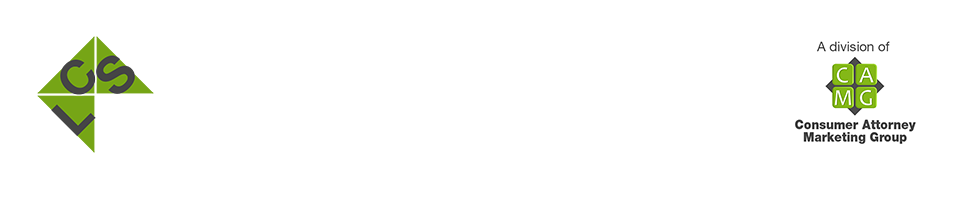
LCS systems are built to handle contract requirements of any kind. We have the ability to digitize and fully automate your contracts and questionnaires. If you prefer to use printed contract packets, we offer high quality printing and mailing services as well. Our process versatility allows your firm the opportunity to take advantage of e-signatures (through our secure web portal) or hard copy packets which are sent directly to your clients, overnight.
Our state-of-the-art, in-house print shop reproduces your documents in full color, on high quality paper, ensuring your brand always looks amazing.
We have graphic artists that can customize the look and feel of your in-packet documentation if needed. Otherwise, we are happy to distribute your pre-made packets, provided you ship us copies to place into our workflow.
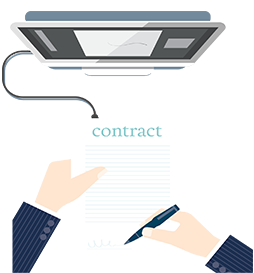
Contract Management
Contract Acquisition
LCS agents treat your clients with the highest degree of respect, patience and professionalism. We focus on getting your clients to sign and return their contracts in a timely manner. Our systems automatically complete as much contract data as possible to ensure your client can return the signed contract with ease. We even provide reusable FedEx envelopes and schedule automated pickups to allow for quick and simple returns.
LCS provides advanced contract tracking services that allow you real-time data throughout the entire process. Our team communicates with your client immediately after packet delivery, which provides you with the greatest percentage of completion. Our contract acquisition services are driven by intelligence that helps us determine the best time to reach out to non-responsive clients. This process allows for fewer calls and higher completion rates.
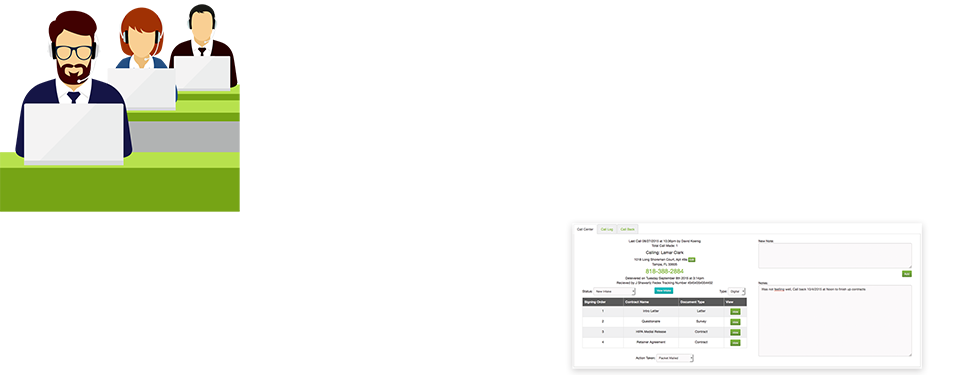
Our dedicated contract processing agents are armed with an intelligent interface, allowing them access to all of your relevant client contract data. This interface provides our agents the ability to walk the client through each item within the contract packet while speaking to the client on the phone. We ensure your satisfaction by using our system to track every step our agents take throughout the entire contracting process.
Document Work-Flow and Storage
LCS has the ability to capture your intake data from any call center. Upon receipt of your intake data, we create your account within our system and provide your call center with a unique email address specific to the campaign. Your contracts are then generated and processed with the data we receive.
Your signed contracts are then sent back to our contracting center for scanning and database storage, and returned directly to your office.

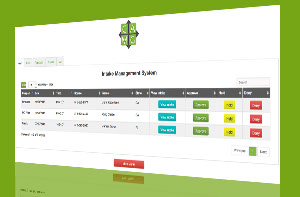
The LCS client portal gives you the flexibility to manually approve or deny intakes, or automate the process completely.
Our proprietary system offers the highest level of visibility to ensure you always have real-time status on your campaigns.
No matter whether your contracts are returned digitally or in hard copy, you have the ability to search and access your digital contracts anytime, directly from our secure web interface.
The Client Portal
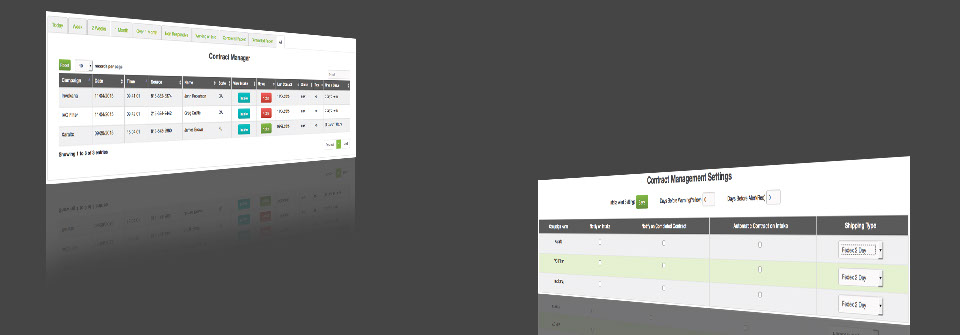
Accountability and visibility are everything to LCS. We track everything we do and share it with you in real-time. You have 24/7 access and know exactly what stage your client contracts are in at any given time.
No one has ever offered such a granular level of contract management within the legal industry.
You control the details of every campaign, from notifications to shipping timelines. Our client portal gives you the visibility and control you deserve when hiring us to do your document aquisition.
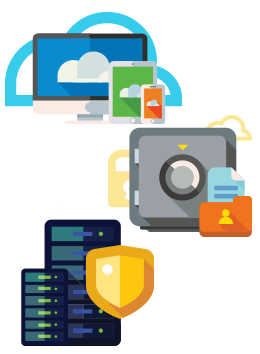
LCS takes security very seriously and when it comes to compliance, we have you covered. We are HIPAA, PCI, FISMA, and FedRAMP compliant and are SSAE SOC 2 Type II Certified. When it comes to your data, we use high levels of encryption and policies that keep your client data safe and secure. Our servers are housed in dedicated, compliant data centers and are regionally redundant. We store all of your contracts in secure vaults while they are being digitized and they are either returned to the firm, or shredded by our NAID-Certified document destruction company, at the firm’s request. Access to client data is limited to employees whose job functions require access and that access is locked down to the exact data necessary to perform their job. All of our networks are accessed internally through private infrastructures and all our employees are vetted with background checks to assure the highest level of confidence in our workforce.
Security and Compliance
CAMG started as a boutique agency specifically designed to help law firms reduce their costs of generating leads, improve lead quality and gain control of the marketing strategy with complete transparency.
With more than 20 years of both direct response management and DR buying experience, CAMG has proven that it has the tools necessary to run successful legal campaigns.
